
Dan Aykroyd’s Crystal Head Vodka Goes Camouflage: The Limited Stunning “Camo Edition”

Dan Aykroyd’s Crystal Head Vodka continues its image-driven seduction strategy: in 2026, the brand launches a limited edition called the Camo Edition, recognizable by its camouflage-patterned bottle.
Designed to make a lasting impression as much as to accompany tasting occasions, this version reinforces the core identity of Dan Aykroyd’s Crystal Head Vodka—already strongly associated with an iconic design and a solid brand narrative.
First rolled out in the U.S. market in May 2026, it is sold at $54.99 for a 750 ml bottle—an approach consistent with the “premium” aura surrounding the brand.
What makes this edition particularly noteworthy is not only its appearance but also the process used to create its aesthetics. The brand highlights a unique decorative method that allows the camouflage pattern to be applied across the entire flask. The goal is clear: to provide complete visual consistency—from the smallest details to the overall volume—and to strengthen the perceived value of a limited edition. In other words, the bottle is not just a container; it becomes a collectible object and a symbol of differentiation for collectors tracking releases of Dan Aykroyd’s Crystal Head Vodka.
Inside, the proposition also seems to aim at meeting modern consumer expectations. The vodka is presented as made from grains, while being labeled gluten-free and sugar-free according to TTB labeling guidelines. These features have become important reference points for many consumers—especially those looking for products better suited to their lifestyle or diet. In addition, the brand mentions 70 calories per serving, offering a “lighter” reading of the alcohol—without changing the nature of the product, but aligning the message with contemporary consumption criteria.
All in all, the Camo Edition illustrates how the makers of Dan Aykroyd’s Crystal Head Vodka use design, decoration technique, and nutrition-related communication to create a highly attractive product. The limited edition draws attention with its military/artistic style, reassures with its claims (gluten-free, sugar-free, 70 kcal), and fits within a brand logic where the container becomes almost an argument in its own right. For an audience that seeks both the experience and the symbolism, this vodka appears to be a thoughtfully crafted choice—one meant to last in memory, beyond the glass itself.
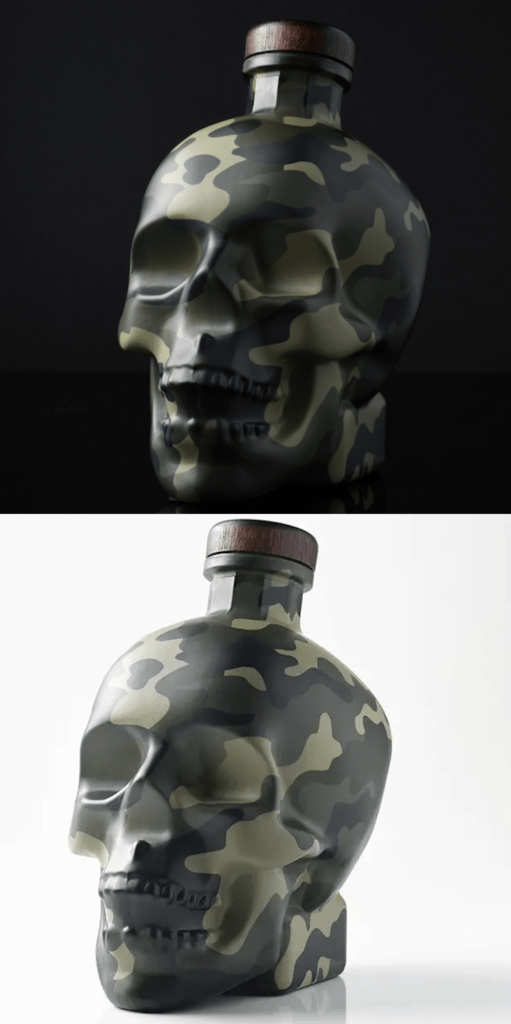
Why Camouflage is Perfect for Dan Aykroyd’s Crystal Head Vodka
Camouflage is usually associated with hiding—blending into the environment, disappearing from view, and remaining unseen. Yet in modern design, fashion, and advertising, camouflage often does something different. Instead of being about invisibility, it becomes a language of style, identity, and attitude. This is exactly how the idea works in the context of Crystal Head Vodka’s 2026 Camo Edition, where camouflage is not used to conceal, but to create a striking visual statement.
First, camouflage draws attention because it contrasts “natural” patterns with strong visual forms. It looks rugged and intentional, and that gives products a sense of boldness and character. The standard release of Dan Aykroyd’s Crystal Head Vodka is already known for its iconic skull-shaped bottle, a design that stands out immediately.
Adding a camouflage motif amplifies that presence. The bottle is not meant to look ordinary or blend into shelves; it is meant to be memorable, competing directly with other high-end spirits reviewed on platforms like Wine Enthusiast. In this way, camouflage becomes a design tool: it gives the product a visual identity that is recognizable at a glance.
Second, camouflage carries cultural meaning. It can suggest resilience, strength, and readiness—ideas that brands often want to communicate without using direct words. The article’s description frames the camo pattern as a kind of symbol, where “heritage meets modernity” and “strength meets style.” These themes turn camouflage into more than decoration. It becomes a metaphor: the design evokes toughness and confidence, even though the product itself is vodka rather than military equipment.
This symbolic meaning is one reason limited editions of Dan Aykroyd’s Crystal Head Vodka resonate—because they feel like they express something about the brand’s values or aesthetic direction.
Third, camouflage helps marketing through scarcity and collector appeal. Limited editions rely on the idea that the product is different in a way that matters. Camouflage accomplishes that difference quickly. It makes the bottle feel like a special variant rather than a routine release.
The production process emphasizes that a unique decoration technique is used to render the camo pattern across the glass, implying effort, craftsmanship, and intentionality. That matters because collectors often seek not only taste but also design uniqueness.
Camouflage gives this iteration of Dan Aykroyd’s Crystal Head Vodka a clear theme that signals “this is not the standard bottle.”
Ultimately, the reason camouflage is used here is not to hide—it is to declare. In this case, camouflage serves as a bold contrast to the bottle’s iconic skull shape, as a symbolic reference to strength and individuality, and as a practical strategy to make the limited edition feel distinct. Camouflage, in this context, does not disappear into the background; it stands out on purpose.

Don’t drink and drive. Enjoy responsibly.
News
Stay tuned and discover all the news in the Spirits World for professionals and amateurs, by our Spirits Hunters’ experts.
See all posts in this category. Join the community on Reddit
Spirits Hunters is a community dedicated to spirits and the world of mixology. Feel free to talk about the world of mixology and bartending here!
Join